Thursday, 5 January 2012

IMRANGANA TAHERATH: A TALE OF TWO SPINNERS...


Immy (left) looks on as Ranga celebrates the win...

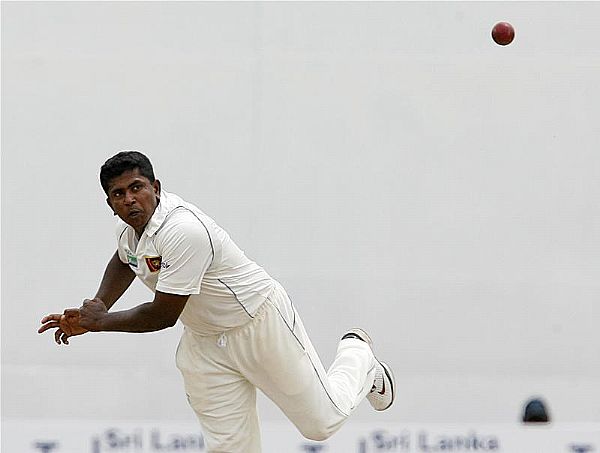
Ask the good folk of Moddershall CC in Staffordshire who was the better spinner – Imran Tahir, club professional in 2004, 2005, and 2008, or Rangana Herath, his successor in 2009 – and it is almost certain that they would say the much-loved Pakistani South African leggie, an opinion that would be heavily supported by their statistics in the North Staffs and South Cheshire League, small sample-size for the latter notwithstanding. However, anyone who happened to tune in to last week’s Boxing Day Test match from Durban – Imran’s new home city – might not have been quite so readily convinced: 48–4–165–3 plays a Man of the Match-winning 50.3–14–128–9, Herath not only more economical, but carrying a greater wicket threat during what was, for a few of us, the slightly surreal spectacle of two ex-teammates of ours battling it out as key protagonists in an international fixture.

Anyway, aside from both being affable spinners (albeit one excitable, the other reserved) from Asia who have pro’d for Moddershall and Hampshire CCC, the two men are bound, like Vladimir and Estragon
by a shared history of waiting...

Stepping out of the shadows
Having debuted for Sri Lanka in 1999, aged 21, Rangana had been waiting over a decade for the all-time leading Test wicket-taker to tire of whirling away in the long form of the game – which he did, finally, in July 2010, signing off with his eight-hundreth scalp – and then had to establish himself as the first-choice option in front of Ajantha Mendis, having previously tussled with leggies Upul Chandana and Malinga Bandara. Imran, meanwhile, had been waiting for the first half of the noughties to get a break for Pakistan, with the considerable talents of Mushtaq Ahmed and Danish Kaneria in front of him (indeed, Moddershall’s top-of-the-table clash with Longton – who had Alfonso Thomas pro’ing for them – in 2005 was, somewhat surreally, watched by an international cricket coach: the late Bob Woolmer, who had travelled up from his Birmingham home to check on Immy’s worthiness to attend a national training camp). Once having wed his future to Sumayya and South Africa, he then had to wait another four long years from the date of his last Pakistan ‘A’ appearance to officially become a Protea – whereupon he endured another 18 months of confusion and red tape – before finally getting the opportunity to play at the highest level of the game, a dream I’ve written about elsewhere.

Both, at times, must have wondered what sort of career they would ever have at the pinnacle. Both must now cement a place in their respective sides. 


Immy: settling in...

Regardless of the comparative merits of the two bowlers, Rangana’s place is notionally a good deal more secure, largely because of the weakness of the Sri Lankan attack in the wake of the retirements of both Murali and Chaminda Vaas, as well as Lasith Malinga’s decision to play only limited-overs cricket. Imran, meanwhile, has gone from an itinerant club pro three-and-a-half years ago to someone who made one of the most eagerly anticipated international bows since Graeme Hick, clearly a function of his new country’s long hankering after a match-winning spinner. Will this instinctively conservative team (and perhaps people) understand how to treat the exotic new creature in their midst? Will each Graeme Smith six-of-one-half-a-dozen-of-the-other field turn up Imran’s tension dial, perhaps bringing about another nervy full toss that arouses in a few of his teammates those yearnings for the steady undercutters of Harro? Will they simply expect too much from him?

Earning confidence
Clearly, Imran’s major weapon is a well disguised (for me, anyway!) and sharply spun googly. By the very highest (orthodox) standards, his stock leg-spinner doesn’t regularly spin sharply, nor drift à la Warne, although it is accurate. In addition, he bowls a decent flipper that can be lethal against lower-order batsman, either as a catch-them-cold, first-up ball or something to use once having dragged their front foot carelessly across the crease with a few well flighted leg-breaks. Anyway, for Imran to become or remain (as the case may be) an attacking bowler at this level, it is absolutely crucial that he earns the right to have a short-leg as well as the slip. In other words, it is essential that his variation carries the threat of taking a wicket, not just of inducing a false stroke and gleaning a moral victory. For that to happen, he needs to have the confidence and trust of Smith (which is a dynamic, fluctuating aspect of their relationship, not something that is definitively achieved, once and for all), and for that to happen, he needs not to haemorrhage runs through overattacking. He needs method, in other words. A 6-3 offside field might be a good option if either the pitch isn’t taking a great deal of spin and thus hes in containing mode, or he isn’t quite on his game (yet must bowl his quota of overs to allow the seamers to rest), but is ultimately defensive in the context of his general modus operandi and he should be encouraged to have either his short extra-cover or cover sweeper as a fourth man on the legside. (I would also recommend, in a post-DRS universe, that he occasionally bowl his leg-break from wider on the crease, so that, after pitching and turning, it was still threatening the stumps / front pad, rather than spinning across the batter’s eyes toward slip. But that’s another story…) 


A rare block from Immy (proof of which being extra cover wearing a helmet...)

This modus operandi was far too good for most – though not quite all – batsmen in the North Staffs League, and certainly allowed yours truly to set fields in a largely headache-free manner. (And yes, I set a 6-3 offside field, but then I’d often forsake mid-wicket for a silly point.) In 2004, after a sketchy start as joint-favourites for the title (Imran had helped his previous club, Norton-in-Hales, to 3rd the previous season and the title in 2002, breaking Sir Garry Sobers’ league-record haul of 104 wickets in the process), our captain walked out four games in to the season, beating a mutiny by hours, and I took over; thereafter, our league results were OK (only one defeat in the remaining 18 matches but far too many draws to challenge for the title) but it was in the cups that we excelled, losing the Talbot Cup final (the intra-league competition) and winning the Staffordshire Cup for the only time in our history. In 2005 we pushed hard for the title, leading until the third-last game as Imran bagged 86 wickets at 12.6, yet ultimately came up short behind a very strong Longton side that contained six or seven Minor Counties players alongside Alfonso. Finally, in 2008, the title was won, Imran taking 80 wickets at 11.14 this time, and at an improved strike- and economy-rate, with no less than 12 five-wicket hauls in the process. And all this having been picked up by Hampshire in mid-July, taking 44 wickets in 7 games for them to help avert relegation. In short, he had secured his legend.


Immy (back row, third from left) celebrates his last act in the small time

In 2009, then, the wee Herath Mudiyanselage Rangana Keerthi Bandara Herath (as I greeted him – and told everyone they must, too – when he arrived three games into the season) certainly had a tough act to follow. All ten or twelve of the Moddershall ultras unhelpfully wrote him off before he had even really started (with a game in near-Baltic conditions on our exposed, hilltop ground, incidentally). However, I had chosen him not on a whim, but with a great deal of care and forethought (Immy, incidentally, had recommended his Titans team mate Roelof van der Merwe, who he told us, either as warning or commendation, “liked a beer,” but who turned out to be a shade expensive). My reasoning for picking Ranga was as follows:

(1) Firstly, a lengthy perusal of scorecards on Cricket Archive informed me that he’d made 88 not out for Sri Lanka ‘A’ in a 50-over game in Benoni against South Africa ‘A’ that winter, coming in at 94 for 6 and seeing them past the victory target a further 200 runs ahead. Impressive. Immy might look like an out-and-out start-the-roller merchant, and it’s true that there was little point in asking him to bat sensibly, but he biffed his way to 431 runs in our championship season and we couldn’t afford a rabbit as replacement.

(2) Second, according to his Cricinfo profile [don’t ever say my research isn’t thorough], he had a carom ball: i.e. a quasi-doosra flicked off the middle finger that spun away from the leftie. Naturally, I absolutely revelled in divulging this tidbit to the local press for their pre-season preview, aiming to create a little trepidation among the league’s many red-inkmongers, my way of saying: “yes, Immy’s gone, but you’re still going to have to come and make tough runs against an international-class spinner on a beach! Good luck with that.” I also collated a list of Herath’s high-profile victims, purring as I incorporated it into an artfully composed sentence-cum-press release used as a further means to make our opponents fret: “Anyone who’s got Trescothick, Chanderpaul, Ponting, Kallis, Inzamam and Steve Waugh out has to be able to bowl a bit. So, all in all, the club is delighted with the signing and are hopeful he’ll be one of the three or four best pro’s in the Prem next year, particularly if the long-range forecasts for a hot, dry summer are accurate.” Mind games, innit.

(3) Thirdly, although he’d played a Test against Bangladesh as recently as December, he’d only taken 1/115, while his 14 games had been spread over nine years (36 wickets at a shade under 40) and Murali still didn’t seem like retiring; ergo he wasn’t likely to get called away, as had Imran for Hampshire…

Is this the Carom ball?

Here’s how all that panned out:

(1) I now know that Benoni is a road. An utter featherbed. Sponsored by Slumberland. And irrespective of the fact that the attack contained Wayne Parnell, it was, for a bottom-handed biffer with three shots in his repertoire (pull, sweep, slog and hybrid forms of those shots), infinitely less taxing than facing clubby dobbers on soft green seamers. Fair to say, the posh side was only really used for leading edges. All this thrust and thrape saw him average a slightly disappointing 22.25: i.e. only about 6 runs better than his current Test average!

(2) With the exception of the Bunsen on which we played Kim Barnett’s Knypersley (always Barnett!)  on which Ranga returned underwhelming and unflattering figures of 21.2–10–31–1 en route to smashing the world record for beating the outside edge (apart from in his first over, when he did induce an edge from the former Gloucestershire, Derbyshire, Checkley and Leek stalwart, only for yours truly to drop the sort of ultra-simple chance that has direct marketing companies pushing laser surgery leaflets through your door)  the wickets were just too green, greasy and skiddy, or slow and tacky when they took turn, rendering his carom ball the proverbial ashtray on a motorbike.

(3) I mentioned above that Ranga was a quiet guy who didn’t show a great deal of passion on the field – certainly not in comparison to Immy, whose kid-jumping-off-the-school-coach celebrations are not an affectation developed for TV cameras – but he was just starting to settle and come out of his shell a little when – guess what? – he was called up for Sri Lanka to replace Murali, who had a shoulder problem. Bollocks! OK, his stats of 112–27–333–14 in his 8 games are nothing to get frisky over, but he was improving… 


Ranga (front row, left) with a trophy: False Dawn

To me, it was evident that he was a quality bowler – Barnett reckoned him the third best spinner he’d ever faced, which made him, in his eyes, superior to Vettori – but, lacking the coruscating variations of Imran, he also had to work much harder for his wickets, in part because our catching was truly abysmal that year, which in turn may have depressed him somewhat, preventing him from emotionally connecting to his new environment as fully as he might. Vicious circle. Furthermore, despite his pudgy, samosa-munching frame, he was also an excellent fielder in the backward point region, and incredibly accurate when throwing down the stumps, a trait that was twice in evidence in his third week with us, when we won the Barney McCardle Trophy (essentially, the NSSCL version of the Community Shield, in which we played the winners of the other three divisions in a four-way T20 competition).

Yet, where Immy blazed through the league like a horde of horny and skint Vikings, all the Moddershall faithful saw with Ranga were their damned lies and statistics: the debut in which, despite bamboozling former Worcestershire all-rounder Roger Sillence, Mike Longmore (who Immy rated one of the best two local batters) scored 104 not out against us (me again spilling a dolly at slip when he had 20); they saw the second game, when ex-Moddershall batter ‘Milky’ Holloway blazed a ton; the trouble-free 80 for Derbyshire’s Dan Redfern at Leycett; the slog-sweep assault by Khalid Malik at Burslem; the 1-fer on a beach against Knypersley… They refused to heed the potential in the phenomenal T20 spell of 4 overs for 5 runs against Porthill, or the sticky-dog ‘Michelle’ against Leek.

So it was that, with us left to hire a succession of overpriced sub pro’s (one of whom – at the time in the first-class game, though not now – was among the most despicably exploitative and self-regarding bandits it has been my misfortune to meet), off scooted Ranga to Galle, where, just hours after stepping off the plane, he would go on to snare his first Man of the Match award (the one in Durban being his second), adding a decisive second innings spell of 11.3–5–15–4 to a couple of useful cameos with the bat as the Lankans beat Pakistan by just 50 runs. In the next game, another victory, he bagged a maiden Test 5-fer as Pakistan lost 9 wickets for 35, a feat he promptly repeated in the third game. He then sat out the First Test against New Zealand – Murali returning and the (at the time) red-hot Mendis preferred – before picking up another 5-wicket haul as Sri Lanka won the Second Test by 96. So much for our 2 wickets per game pro!!

It was a veritable head-scratcher, alright. Perplexing. Bewildering.  

Perhaps, ultimately, it was a warm weather thing. Y’know: needing to have feeling in his fingers – neshness like that. For no sooner had he bagged his Kiwi five than he was back in the UK for a three-game stint as overseas pro with Surrey, picking up dismal aggregate figures of 8 for 431 from 108.2 overs of toil in three Division 2 runfests (being outbowled at Wantage Road by Nicky Boje, incidentally). He wouldn’t fare much better for Hamsphire the following spring, either, nor for his country last summer, aside from a decent spell at Lord’s. But the key drawback he faced at Moddershall was that, where everyone knew Immy could rip out a side’s heart in half-a-dozen overs or so, he simply could not. Had it been Lancashire, ’appen tmembers’d’ve brok ’is fingers ’n’ put ’im on next boat ’ome...

But I could see a good cricketer – a good club pro – in that shuffling approach and snappy, narrow pivot; in the chest-on delivery that imparted all the revs (and the curve, the drop) from the shoulder; in the clever use of the crease – something Imran, less guileful, more heavy artillery, didn’t do – and in the round-arm variation that either undercut or would spin sharply; in the lesser-spotted carom ball; and in the cultic slogging. It’s a shame, I guess, that he saved his best performances for the Test arena…

Cultic slogger saves best for Tests...


Epilogue

While Ranga was bagging wickets in the Tropics, Moddershall, meanwhile… Christ, where to begin? With a thrice deferred PhD thesis to finish and my motivation at what I thought was an all-time low (it wasn’t: the following season was worse), we were slipping inexorably toward relegation, a fate I thought all but inevitable when, four games from the end, our never-before-seen-or-heard-of hired help arrived at Little Stoke looking like Dev from Coronation Street’s rotund elder sibling, and proceeded to bowl (half-decent off-breaks) in silver Nike trainers while sporting some horrible, generic baseball cap 
 backwards!!  doubtless to conceal his bald patch. Oh Lordy. 

Incredibly, we won the game… I say 
incredibly’ – actually, it was pretty much down to an utterly ludicrous decision by our opponents to play on a very badly worn pitch (they cannot have thought that ‘Dev’ was a seamer, surely?!), the sort of deck on which either Ranga or Immy would have taken 7/30, at least. Anyway, this performance (3-fer and 30) bought him two more matches before he was mercilessly axed for the final game, for which, unable to persuade (Joe Sayers to persuade) Ajmal Shahzad that £700 was preferable to a weekend in London, we went back to our right-armed bandit, whose 9/39 on a rug kept the club safely in the Premier League in what was the most unsatisfactory, sour-tasting, last-ditch escape imaginable. 

During all this hoo-ha, I had discovered that nothing is quite so tiring as talking to cricket agents all week, trying to get value for money in what was always a seller’s market but became even more so in the wake of the UKBA’s tightening of its immigration policy and the ECB’s more stringent rules for qualification of overseas cricketers. Add to this the fact that our league administrators deemed that any player who had subbed for any club in any of the four divisions could thereafter play for no other club in the league that season (a change brought about by Shahid Afridi playing for and against the same team in consecutive weeks in 2003) and it was very tough indeed to find quality replacements. So, for the 2010 season, I simply had to select a pro who would absolutely never get called up for representative honours, be that county or national.

After much searching we dropped on a seamer who, by October 2009, had played just the two first-class matches (for Khan Research Laboratories), about whom the reports were good, and whose height would be a useful tool on damp English pitches. And boy, was he tall – so tall, in fact, that he didn’t exactly slip under the proverbial (or literal) radar; so tall that he might have shown up in Air Traffic Control, but was certainly spotted by the Pakistan national coaches, who first invited him along to a training camp and then, a couple of weeks before our season started, fucking went and fucking picked him for the tour of fucking England. This bowler was the 6’10” (or 7’2”) Mohammad Irfan. 


I like the look of the bloke on the right... 
And so it was that I spent another 12 longs weeks on the phone to agents that season, slowly but surely cracking up. And so it was, too, that, barely 20 months after Imran finished with us – 20 months after the pinnacle of my cricket-playing days – my desire to play cricket was finally extinguished.


Friday, 30 December 2011

ALL-TIME APOSTROPHE XI


Capt. Basil

I suppose, looking back, there’s an outside chance that it was all fevered or dreamy or intoxicated reverie, half a chance that I only imagined that strange conversation in the pub about apostrophes and sportsmen which at the time I reported as fact, but now am prepared to admit – or at least to entertain the notion – that it may not have actually taken place, a conversation in which it was suggested that a little known, flash-in-the-pan, medium-fast Kiwi left-armer was the best cricketer ever with an apostrophe in his surname. (I know it’s ludicrous now – but at the time I hadn’t thought of him. Or him.)

Anyway, in an act of frankly pathetic self-plagiarism (if such a thing is possible), I then recycled this almost certainly imaginary conversation, only this time it was about apostrophied footballers, of which there are many and from whose number I’ve subsequently selected a formidable team, from Preud’homme to Eto’o, with the likes of Guivarc’h on the bench.

And that is where I had parked this ground-breaking, epochal research project until last month, up until the point at which the sheer volume of complaints, lobbying, and desperate, suicide-threatening pleas from Joe and Josephine Public compelled me to pick up the original baton and – in the light of a completely fabricated barroom debate – choose a bunch of cricketers with names carrying this most vexatious (and, in the vanguard linguistic city of Birmingham, redundant) of punctuation marks.

After an intensive four-week period canvassing the mover’s and shaker’s (and grocer’s) of global o’pinion, at long last I’ve settled on my Cricketing Apostrophe XI, competition for which was fierce. As I said before, the game that my fantastical team would find itself playing would be a Punctuation Shield Final, inevitably against the Hyphen XI (a decent side, with their Hamilton-Browns, Inzamam-ul-Haqs and Fleetwood-Smiths). I say inevitably, yet I suppose it’s theoretically possible that you could also assemble a team of accents – acuté, gràve, circûmflex, tĩlde, ümlaut, çedilla, čaron, kål and suchlike (no doubt skippered by the redoubtable Chris Tavaré) – although I’m not sure what sort of game this rag-tag and heterogeneous bunch’d give either the palpably united Apostrophes or Hyphens in the Punctuation Shield semi-finals…

But I digress.

Here it is, then: my grammatically homogenous team, veritable Aryans of the apostrophe. (Note that no Sri Lankans have made the team, despite most scoreboards having little choice but to apostrophise their surnames.) Clearly, it is less graphematically appealing than the Footballers XI, for the simple reason that cricket – corralled as it is in the former British Imperial territories (and thus, apostrophe-wise, largely restricted to the Celtic tongue, give or take a Goa and a flow-a from Samoa) – lacks the linguistic diversity of the footballing world, which can call on such apostrophe-bearing languages as Italian, Portuguese, Dutch, French, Maltese, Hebrew, sundry Polynesian and Bantu tongues, and of course the Celtic stuff, from Irish to Breton. Anyway, I’m sure you’ll forgive me for balancing the understandable desire for that frisson of orthographical unorthodoxy with having to pick a competitive team. (For the Punctuation Shield, as I say.) Otherwise, well, I’d have bunged in Maurie Fa’asavalu – a rugby player, true, but a quality apostrophe.

But still I digress. The team…

Oh, they shall play at Lord’s. Where else?


 O'B 

CRICKET’S ALL-TIME APOSTROPHE XI

1: Norm O’Neill (Aus)
Described by Gideon Haigh on his Cricinfo profile as a “broad shouldered adonis who gave off a golden aura of good health,” the tough-as-teak opener averaged 45 across 42 Tests, his PB of 181 coming in the tied game of 1960 in Brisbane, yet is widely considered an underachiever. Not in this side, he ain’t.

Bits-and-pieces Lancastrian famous for winning the Walter Lawrence Trophy by equalling Percy Fender’s 63-year-old record for the fastest first-class century in terms of time (35 minutes), runs blazed off the fearsome new ball attack of DI Gower and JJ Whittaker. With MCC knickers starting to twist, the feat was soon revoked, relegated to an inglorious footnote in Wisden entitled “contrived circumstances”.

3: John D’Arcy (NZ)
Mr D’Arcy played 5 Tests for New Zealand as an opener – all in England in 1958 – and yet didn’t make a single first-class century in his entire career. Not one (grip problems, apparently). Kiwi strength in depth. Former Derbyshire batsman Tim O’Gorman is pushing hard for selection, it has to be said.

4: Basil D’Oliveira (Eng) captain
The late D’Oliveira will forever be remembered as the man who in 1968 faced down apartheid, leading to his homeland’s 25-year exclusion from Test cricket. He was also a fine batting all-rounder who served Worcestershire with distinction, a legacy continued by son Damian, now academy director. (Probably also sneaks into the yet-to-be-selected Herbs XI.)

5: Niall O’Brian (Ireland) wicket-keeper
Another off the production line of inventive ginger-haired Irish left-handers, following Eoin Morgan and Ed Joyce (no, I will not debate whether the latter was inventive or not). ’Keeper in this team (yes, I do insist on the apostrophe to mark the elision of wicket- because it’s not “just the same as phone”).

6: Ted a’Beckett (Aus)
Toured England in 1930 with Bradman, playing at Leeds when The Don made his country’s highest Test score of 334. Doubting Thomas was a relation.

All-rounder who played for Australia when they were gash. Wouldn’t have got in the side as either pure batter or bowler, and shouldn’t really have done as an all-rounder either, although he once smashed an 18-ball half-century and did a half-decent job in the ODI team when they won the 1987 World Cup. Now presents Channel Nine’s lunchtime show – presumably because he’s good at hawking merch and casually littering his sentences with mentions of their “corporate partners”.

8: Kerry O’Keeffe (Aus)
The ABC commentator with the infectious giggle wouldn’t get within a million miles of any other representative XIs – save perhaps Players Who Rhyme With Beef – but that cheeky little apostrophe sneaks the leggie into this all-time XI as second spinner ahead of near namesake Steve O’Keefe. Kiwi swinger Shayne O’Connor would play on a green’un.

9: Bill O’Reilly (Aus)
Genius purveyor of fast, spitting leg-breaks and top-spinners during the 1930s who took a gross of Test scalps in his 27 games, including 27 in the Bodyline series, and was rated by Richie Benaud as at least the equal of SK Warne. He also disliked Bradman intensely. Kudos.

10: Iain O’Brien (NZ)
Big-hearted self-professed depressive who spent a bit too much time playing league cricket in Derbyshire before pulling his finger out of his backside and bringing an air of genial club cricket to the Test arena as he ran uncomplainingly into gale force winds, nibbled it around, and made a bunny of Mahela Jayawardene. Underrated (although not quite good enough as sub pro for Leek in 2008 to stop Moddershall winning the North Staffs & South Cheshire League title).

11: Murphy Su’a (NZ)
Was born in Wanganui, which is pretty much what he did as a cricketer… Middle name: Logo. Stout-hearted, stout named.

POST SCRIPT:
Indeed the Apostrophes shall play the Hyphens, as Rishabh @CricketNerdist has taken up the challenge and selected an all-time double-barrelled outfit, which you can take a look at here. Controversially, theres no place for Rory Hamilton-Brown, a.k.a. the white Asad Shafiq (perhaps because the hyphen is an affectation of his fathers), nor Misbah-ul-Haq. Assuming nobody wants to select a team of Accents (and beyond Chris Tavaré, I'm not sure I know any), all thats now required is for some maths genius to work out the outcome based on some incomprehensible algorithm or other. Or maybe aggregated career averages. Volunteers? 


Wednesday, 21 December 2011

HITTING THE DECK HARD

Stray balls lying around cricket grounds are a hazard, a nuisance. In the past, they have been known to change the course of cricket history: Glenn McGrath in Birmingham, 2005, being the most obvious example. Now, for all that they're a commonplace sight, I'm pretty sure I've never seen one actually heavy-rolled into the cut strip. This incredible photo comes, I think, from Aussie grade cricket – appropriately enough, you might say, for the embedded ball resembles nothing so much as a meteorite that collided with the earth, à la Uluru, say. 

Speaking of McGrath, you imagine that, were he confronted with a ball buried in the pitch like this, he'd probably be looking to hit it four, maybe five times an over. Mind you, it looks just a yard short of his in-between length...


Tuesday, 22 November 2011

LIVING THE DREAM...

And so, finally, it came to pass: after a long journey from Lahore to Durban via Stoke-on-Trent, and an equally arduous existential journey – changing his nationality, no less Imran Tahir, at 32-years-young, fulfilled a lifelong dream and played Test cricket. Regular visitors to this blog (ha ha!) will know that I have written previously about the much admired former professional of Moddershall CC – at the time of his bow in international cricket at this year’s Cricket World Cup, to be exact – and these achievements feel as gratifying to all those who shared three great seasons with him at Barnfields after he had been signed from Norton-in-Hales in 2004 (for whom he took just 7 wickets in 4 games against Moddershall as we picked up 95 points and four wins; even so, it was still a pretty safe punt, we felt...) as I am sure they feel for him.

With Immy as pro’ and yours truly as captain, Moddershall won the Staffordshire Cup in 2004 whilst losing the final of the Talbot Cup that same year to Audley – a day that began for me in Cambridgeshire with an almighty hangover; a game in which I not only skippered but kept wicket, too (reluctantly, as always), and in which Immy repeatedly forgot to give me the signal that the googly was coming (a scratch of his bowling mark), these balls thus being not only too good for TP Singh, their left-handed pro, but also the ‘keeper that was to have stumped their dangerman… The following year, we almost, almost pipped a super-strong Longton side, spearheaded by Alfonso Thomas, to the Premier League title, having had our club game watched by then Pakistan coach, the late Bob Woolmer. Then, after a two-year hiatus for us both – Immy at Meir Heath and up north, me at Wollaton in the Nottinghamshire Premier League – we pulled off a truly remarkable North Staffs & South Cheshire League title victory in 2008, a season in which Imran first started to flicker more brightly on the wider cricketing consciousness.

Today, if not quite yet a superstar, he is certainly very highly regarded, enough to be frequently spoken of as the missing ingredient in the South African attack. Indeed, that was the thrust of the ever-brilliant Barney Ronay’s piece on The Guardian’s website last week, which describes the “hitherto globetrotting Pakistani impresario of the leg-break and googly” as “the most familiar of debutants, a baby-faced 32-year-old” and “bowler of rare talent”. His conclusion? “South Africa, twenty years after re-entry in international cricket, finally have a proper spinner”.

Now, if you take a quick squizz ‘below the line’, you’ll notice that a certain ItsGoingIrish left a comment that, at the time of writing, has received 59 anonymous ‘recommends’ and several heart-warming, pseudonymous responses further down the thread. Indeed, the author himself tweeted that the post was “easily the best thing” about his article. It is an uplifting tale (I assume Mr Ronay was talking content, not form). 


My post – for ItsGoingIrish is I; it s a fair cop, guv – sought to let the wider cricketing public know just what a solid chap Immy was – is – by telling the story of his efforts for Moddershall in 2008, efforts that, if not quite above and beyond the call of duty, were undoubtedly something that spoke of a loyal, committed, and devoted cricketer, as well as a thoroughly genuine bloke. (I should point out, by way of counterpoint, that it’s none too difficult to think of another Imran that played for Moddershall, one who – as a man of slightly more self-regarding bent and not quite so much of a team player, truth be told – would not, I think it’s safe to say, have schlepped across the country out of any sense of ‘moral duty’ to help our club. Or any club, probably.)

Champions' post-season de-brief

Anyway, here’s the tale I posted, with a couple of slight amendments for the sake of colour and/or clarity (albeit maintaining the brevity with which I’m not usually associated):
    In 2008, Imran was playing for Moddershall in the North Staffs & South Cheshire League, wheeling away uncomplainingly, bagging his five- and seven-fers, pestering the groundsman to play on the same track next game (we did, several times, and Kim Barnett’s face was a picture when he saw one such Bunsen), and badgering me to move up the batting order from No7 (I occasionally let him swap with me at No6 but he hardly ever played the situation: heart-attack material).
     And then, out of nowhere, Hampshire signed him.
    Our chairman at the time, being the sort of trusting soul readily found among the armies of volunteers who put their love and sweat into England’s many cricket clubs, was perhaps not the best man to deal with Imran’s new – a few days new – agent, and so, with this agent telling Hampshire CCC he had some spurious verbal agreement with us, the club found itself having to haggle with Hampshire over compensation.
    Forcing Immy to keep his contract with us (even though we were in our rights to do so) was not an option, as we had no desire to stand in the way of his cricketing ambitions, naturally, but it’s fair to say that Wee Club in the Shires were not really being heard, or even listened to, by the county club, who merely referred us to the agent. The agent offered us a derisory sum, one far short of the remainder of his deal – and that’s without even considering the rent on his house (6-month contract), the return airline ticket (and we’d need another for any sub we’d have to fly in ... although that was the time the UKBA and ECB regulations started to make this a very protracted procedure indeed), the car...
    In the end, the agent told us we would have to get further compensation from Immy himself. We tried Hampshire again, actually threatening them with holding Immy to his contract. Nothing.
    More than a little vexed, Immy looked at the remaining fixtures of both Hants and ourselves and told me that he’d be free to play 5, maybe 6 out of 9 games (we were second in the table at the time) and that he’d inform Hampshire that he wanted to play for us whenever possible (and remember, by this time he’d had a couple of false starts with his county career, at Yorks and Middlesex, so wasn’t in a strong position to start making demands).
    It turned out that, for the rest of that season, we played only once without him (another game was abandoned after we’d hired ex-Zim seamer Gary Brent as sub, an absolute gentleman who refused his payment, taking only petrol money) and went on to win the Premier League title on the last afternoon, Immy making a golden duck, as it happens, but celebrating the crucial bonus point-securing wicket with a run and scream every bit as intense and sincere as those at the CWC in March, or during his record-breaking debut 12/180-odd against Lancs at Old Trafford.
    He finished that season with 44 wickets in seven Championship games for Hampshire, as they avoided the relegation that had seemed likely when he joined. For Moddershall, it was 80 at 11. But by far the most significant statistic was the mileage Imran did on the motorways in order not to let us down.
    On one occasion he phoned at 4pm on a Thursday afternoon, tea on Day 2 of a Champo game, saying it’d definitely be finished by the “end of tomorrow” and that, after all, we wouldn’t need a sub for the weekend (he was right). On another, he finished a Championship game at Southampton on the Friday, played for us in Stoke on the Saturday (skipper asking him to bowl unchanged from one end), then CB40 in Taunton on the Sunday. This was dedication, love, generosity.
    Imran played three years with us and I never once heard anyone say a bad word about him. If rewards in sport were doled out on the basis of the size of a player’s heart, Immy would have a glorious 3 or 4 years in Tests to adorn his career.
    A fine man, indeed.
Immy, fingers at Barnfields are crossed for you. I hope the rest of your leg-spinning days bring plenty of successful miaows... 

* You may also enjoy the comparison of Imran's spell at Moddershall with Rangana Herath's 


Wednesday, 2 November 2011

NOTTS ON FOREST

Neighbours, everybody needs good neighbours...

What happens to Notts CCC’s cricketers when the summer wanes and winter reclaims the hallowed Trent Bridge outfield? Well, a couple of the squad’s local stars – Bulwell behemoth Luke Fletcher and Giltbrook-raised Samit Patel – often make the 2,742-step journey from the dressing rooms (that’s right, they hibernate in there during the winter), along past the Trent Bridge Inn, over Radcliffe Road, down Pavilion Road, then right to the City Ground: their Mecca. I intercepted Fletcher and Patel along this Pilgrim’s Way and asked them about their love of Forest, the Notts lads’ footballing skills, and other Beautiful Game-related matters...

How long have you been Forest supporters?
LUKE FLETCHER: Since the day I was born, I think. 22 years.
SAMIT PATEL: 26 years.

What’s your first Forest memory?
FLETCH: First memory was losing to Man Utd, 8-0 or 8-1 or something. Ole Solskjaer came on as sub and scored four [this is still the record home Premier League defeat]. I probably went before that but can’t remember it.
SAMIT: They lost to Southampton at the City Ground, 3-1 I think, and all I remember is just running for safety.

Ever been tempted, during the hard times, to ditch them for one of the big clubs – Liverpool, Man Utd, Arsenal, etc?
FLETCH: No, not at all, not at all. I’m not a glory boy.
SAMIT: No [However, Samit admitted that, if he did, he’d choose Man Utd].

How many times per season do you get down to the City Ground?
FLETCH: Well, I’ve been away the last three winters to play cricket in Australia but I’ve managed to squeeze a few games in here and there. I was there against Blackpool a couple of years ago in the playoffs when they lost. I try and get down a couple of times a year but this winter maybe I’ll be able to make it every other week.
SAMIT: Probably about 10 or 12 times, I’d say.

What’s the best Forest game you’ve been to?
FLETCH: Sheffield United at home, 4 or 5 years ago, when Johno [David Johnson] was playing. Semi-final of the play-offs. We won 1-0, I think [research suggests this must be the (poorly remembered) 1-1 draw in 2003].
SAMIT: Beating Leicester 5-1 a couple of seasons back.

Who is your favourite current player?
FLETCH: Big Wes Morgan. Solid as a rock.
SAMIT: Luke Chambers. He waited patiently for his chance but is now the first name on the team sheet, for me.

Who is your all-time favourite Forest player?
FLETCH: Stuart Pearce.
SAMIT: Brian Roy.

What do you want from Steve Cotterill?
FLETCH: I don’t know. If he gets us to the Premier League then he’s a legend, but if he doesn’t then he’s no different from the others, I guess.
SAMIT: Same as everyone else: I want him to make some good signings that’ll take the club to the next level – the Premier League.

Having watched a few of the squad’s morning warm-ups – proper ref with a whistle, two linesmen, Champions League theme tune playing over the PA – it’s obvious you guys like your footie. Who is the best footballer in the Notts CCC squad?
FLETCH: This is a tough one… We run a Power League side and we’ve got a few good players there, but I’d probably say the best out-and-out footballer would be Scott Elstone. He’s pretty sharp. He’s got good skills, good passing, tackles well, finishes well… But let’s be honest, I’m the best goalkeeper on show at the minute.
SAMIT: Chris Read. Natural athlete. Good engine. Always has time on the ball.

Which famous footballer would you say you’re most alike?
FLETCH: Neville Southall.
SAMIT: Jan Molby.

Jan Molby or Samit Patel?

If you were captain of a game of football among the squad – picking teams alternately, like in the playground – who would be the last one in the squad to be chosen?
FLETCH: I’m going to go for David Hussey when he’s around: he’s clumsy, he’s Australian, he’s not really got a clue what he’s doing.
SAMIT: Luke Fletcher. He’s terrible.

Which current Premier League manager is Mick Newell most like? He reckons Arsène Wenger, because he’s “philosophical” and has “a good accent”.
FLETCH: I’m going to go for Sir Alex Ferguson. He gets the best out of players, Mick; he’s got a lot of experience and has won two County Championships, which is a good achievement.
SAMIT: Erm… I’d say Owen Coyle. [Libel laws and our desire to see Samit remain on the staff at Notts prevent us from publishing his reason for this comparison].

Have the European Cup-winning goals ever popped into your head at an inappropriate moment, as Archie Gemmill’s World Cup wonder goal does for Ewan McGregor’s character in Trainspotting?
FLETCH: I can’t say they have to be honest. I have seen the goals, but they’ve not popped in my mind at a, um, random moment.
SAMIT: Er, no.

Prior to the League Cup game with County, you both thought it’d be a “walk in the park”, “nice to give the kids a run”, and said “you won’t even bother going”. Given that the epic 3-3 encounter might have given you some new-found respect for the neighbours, I was wondering: if getting a Notts County tattoo somewhere on your body would guarantee Forest going up this year, then winning the Prem next year, and the Champions League the year after that, would you do it?
FLETCH: No, not at all. I’m a fan of tattoos but I’m not a fan of Notts County’s badge. I wouldn’t do it even if it meant Forest winning the European Cup for the next 10 years!
SAMIT: No. Couldn’t do that. Sorry.

Have you ever walked through town at night, hugged the Brian Clough statue, and said “thank you”? If not, have you ever thought about it?
FLETCH: I’ve definitely stood and had a picture there with Cloughie…er, and I probably have hugged him, too, to be honest. But I don’t think I’ve said “thank you”.
SAMIT: Not thought about it, no, but I’d definitely do that if it got Forest promoted.

Nottingham Power League shot-stopper, Luke Fletcher

If you had a statue built for yourself in town, like Cloughie, where would you have it and what pose would it be making?
FLETCH: I’d be in a wicket-taking pose, or appealing for an LBW, and I’d like it to be next to Cloughie [yes, we’re all surprised he didn’t say on Fletcher Gate in the Lace Market… The Notts supporters certainly think Fletcher’s gate is wide enough to get a tram through it].
SAMIT: Outside The Living Room in the Lace Market, holding a beer.


Interview originally published by LeftLion.


Sunday, 9 October 2011

IN PRAISE OF VIRAT


So, today’s the final and, despite what I might have written elsewhere, I’m quite looking forward to it. Not quite; a lot. Yes, there are still aspects of Twenty20 cricket – and Indian-hosted T20, in particular – that are likely to bring on nausea (the supper-singing hyperbole of the commentators, and the all-singing, all-dancing Yankeefied razzamatazz make it the cricketing equivalent of a non-stop diet of chocolate cream cakes), but, to paraphrase the subtitle of the Peter Sellers movie Dr Strangelove, I have Learnt to Stop Worrying and Love CLT20. (And yes, this is despite it clearly being an unlevel playing field, the tournament structure blatantly gerrymandered to allow Royal Challengers Bangalore to remain at home for the semi-final, despite having been runners up to Somerset in the group.) 

The tournament has been a harum-scarum ride, with Dave Warner’s twin-peak pyrotechnics ultimately eclipsed by Gayle’s brutal power (112 metres!!); with the crafty, grafting cricket of Somerset and Trinidad & Tobago, the two teams that freelance biffer Keiron Pollard might have played for had Mumbai Indians not had first dibs on him; with the virtually unplayable yorker-bouncer-slower ball combinations of Malinga the Slinger; with close finishes galore to keep the neutral absorbed (or at the very least not tempted to see what dress Rachel Riley was wearing on Countdown). 

But most of all, there’s been Virat Kohli, the kind of guy who, to borrow a favourite metaphor of the current India coach, brings a lot to the party. In fact, he probably rocks up to every soiree with a platter of exquisite canapés, a selection of quality wines and a chocolate tort (compliments of RCB), such is the range of his shot-making ability. 

I will come out and say it: I have not been as thrilled by a batsman for a long time. For all the ball-munching excellence of Trott and Bell or the occasional audacity of Morgan and KP, the current England team does not simultaneously take the breath away and have you purring in acknowledgement of cricketing correctness. For all the monumental batting feats of Ponting, Hussey and Watson, Kallis, de Villiers and Amla, none are particularly easy on the eye. Same goes for the best of Pakistan, New Zealand and West Indies. Oh, and Tamim too. 

Then there’s India, that vast nation of iron-wristed batsmen. In terms of purity of stroke and easy elegance, Ajinkya Rahane is close, but not quite Kohli’s equal (there is the chance, of course that this could be the whole throbbing spectacle distorting my perspective and usually impeccable judgment). Dravid, Laxman, Sehwag – great players all, but none of them are so completely classical as is the 22-year-old from Delhi (Laxman and Sehwag are not big movers of their feet, while the King of Method, Dravid, is often bailed out by lightening hands and defensive instincts). So it is probably not since Lara and Sachin that I have been as turned on by a level of batsmanship that more or less says to the bowler: “whatever you have, it’s probably not enough.”  

Talking of quick hands, Kohli wields his willow like a ping-pong paddle, bringing the blade through an extraordinarily pure arc, too, whether tucking it into the legside, clipping it wide of mid-on or playing his signature stroke: the lofted extra-cover drive, hands accelerating up through the hitting area like a golfer. This shot is not played inside-out, with fade, as it is for so many who hit the ball well in that area, for Kohli simply lasers it to his intended target (more or less to the exact seat number) and can also hit the ball bolt straight down the ground. Actually, it is often his footwork that determines where the ball goes, the hitting arc dictated by body alignment. 

But all this technical talk is already to take some magic away, to render it matter of fact, scientific, when it is clearly the work of an artist, a genius. Yes, he has those two founding principles of all the great players – balance and picking up length – but what I marvel at in Kohli is his manipulation of the field, the physical (balance) and perceptual (length-judging) feeding into the cognitive act of shot selection, then back into the physical (the motor system). The shot selection hasn’t always been flawless in this tournament, but such is life in the overheated world of Twenty20. However, just watch how he plays the ball on the offside, steering the ball either side of the backward point, gliding it fine of third man, forcing the offside configuration to move clockwise in synch then drilling the ball over extra-cover (or, utterly fearlessly, straight over long off).

Kohli’s manipulation of the field is only possible because of the glorious palette at his disposal (not all great players have such breadth of options). And as is often the case with batsmen who have such liquid shot-making possibilities, there is a tendency to be too self-critical when perfection isn’t reached. Watch Kohli mistime a drive or misplace a ball and he will berate himself ferociously; again, this could be a symptom of the context rather than intrinsic to Kohli himself, but it speaks of a fierce will. Is this too excitable? Perhaps, but by and large he appears capable of immediately re-focussing. And when he does, he plays without fear (is this why the shot selection occasionally askew?). I’ve lost count of the times I’ve though ‘you just need to nudge twos and put the bad ball away’ only for him to launch it into the stands. 

To grasp the jack-in-the-box Kohli’s sheer enthusiasm for the game, you only have to observe him sat in the dugout, up and down, touching colleagues, chatting, chirping, living and breathing every single ball. You’ll often find him alongside his coach, Anil Kumble, and a cynic might be tempted to surmise that he was a teacher’s pet. But that hypothesis doesn’t stack up: there is no question of him needing to creep in order to advance up some notional pecking order; alongside Gayle, Dilshan and skipper Vettori, he’s clearly at the top of the RCB food chain, frequently consulted by his skipper on bowling changes. You only need to see how he speaks to such veterans as Mohammad Kaif to realize he exudes seniority, an authority deriving from both charisma and on-field performance. And he takes responsibility, the hallmark of any leader. 

In fact, with India having been utterly demolished in England this summer, it would make sense for Duncan Fletcher – if indeed he is able to make such a decision – to install Kohli in the Test team without further ado, and to make him vice-captain to Dhoni. This will not compensate for the lack of bowling penetration, the discovery of which remains India and Fletcher’s greatest immediate challenge, but it will ensure there is no apathy on the field. And after the cricket they played here, at times, that can only be a good thing. 

But first things first: the CLT20 final is here (you may already know the outcome). Having been central to RCB’s back-to-back 200+ chases, definitely no second fiddle to the celebrated T20 batting imports Gayle and Dilshan, we wonder whether the young man born on Guy Fawkes’s Night has one more display of stroke-making fireworks left in him. If he carries his team home, then the livewire tattooed extrovert with the pumping fists and bulging eyes can be anointed as the new face of a modern, confident India.